Looking after our imagination

Last week we looked at what’s happening in our creative brain — two large networks, our critical mind and our imagination, working together to bring things into being.
Today I want to talk about how we look after that second piece, our imagination. How we build strong and healthy imaginative brains, so they’re there when we need them.
Where our imagination lives
Our imagination lives in a part of the brain called the Default Mode Network (DMN) — a complex set of functions that switches on when our brain is idle; when we’re not focused on particular tasks and our brain has space to dream, wander and explore.
The DMN is responsible for spontaneous thought and intuition. It’s the part of our brain that can surprise us. It makes unexpected connections and gives us our gut feel.
It’s also where our sense of identity and purpose lives. And in creativity, it’s the birthplace of ideas.
So, how do we look after our DMN or imaginative brain?
let our imagination switch on
The first step is that we have to actually let this part of the brain switch on.
That means giving ourselves downtime. Unfocused time. Time to dream, to wonder, to follow our curiosity and see where the mind goes.
And for most of us that means, in the first instance, putting down our phones.
Gah, the dreaded advice we all know to be true.
Speaking to myself as much as anyone here, there is nothing more impactful we can do for ourselves and our imaginations than developing healthy boundaries with our phones, and social media in particular.
But it also means time without news, podcasts, TV, books, other people, even blog posts!
We’ll all have different distraction tools and habits. So the first step is understanding yours, and starting to build in free, idle, unfocused time — letting the imagination switch on.
use our bodies
Many of us worry that idle time will invariably lead to unhelpful rumination. And it can, especially when our brains are out of practice. It can feel risky to just be with ourselves.
That was me this past weekend, in fact — you know those days that just feel like a generalised mix of hopelessness and despair? The unbridled imagination can be hard during times like those.
This is where our bodies, and a little bit of gentle focus, can help.
Giving our bodies something simple to do provides the wandering mind with helpful guardrails. Walking, biking, doodling, cleaning, cooking, writing by hand. Any small, low stakes physical or creative practice where our bodies are involved.
For me this weekend, after wallowing in my feelings for a while, I made these dark little doodles and went for a walk. And it helped.
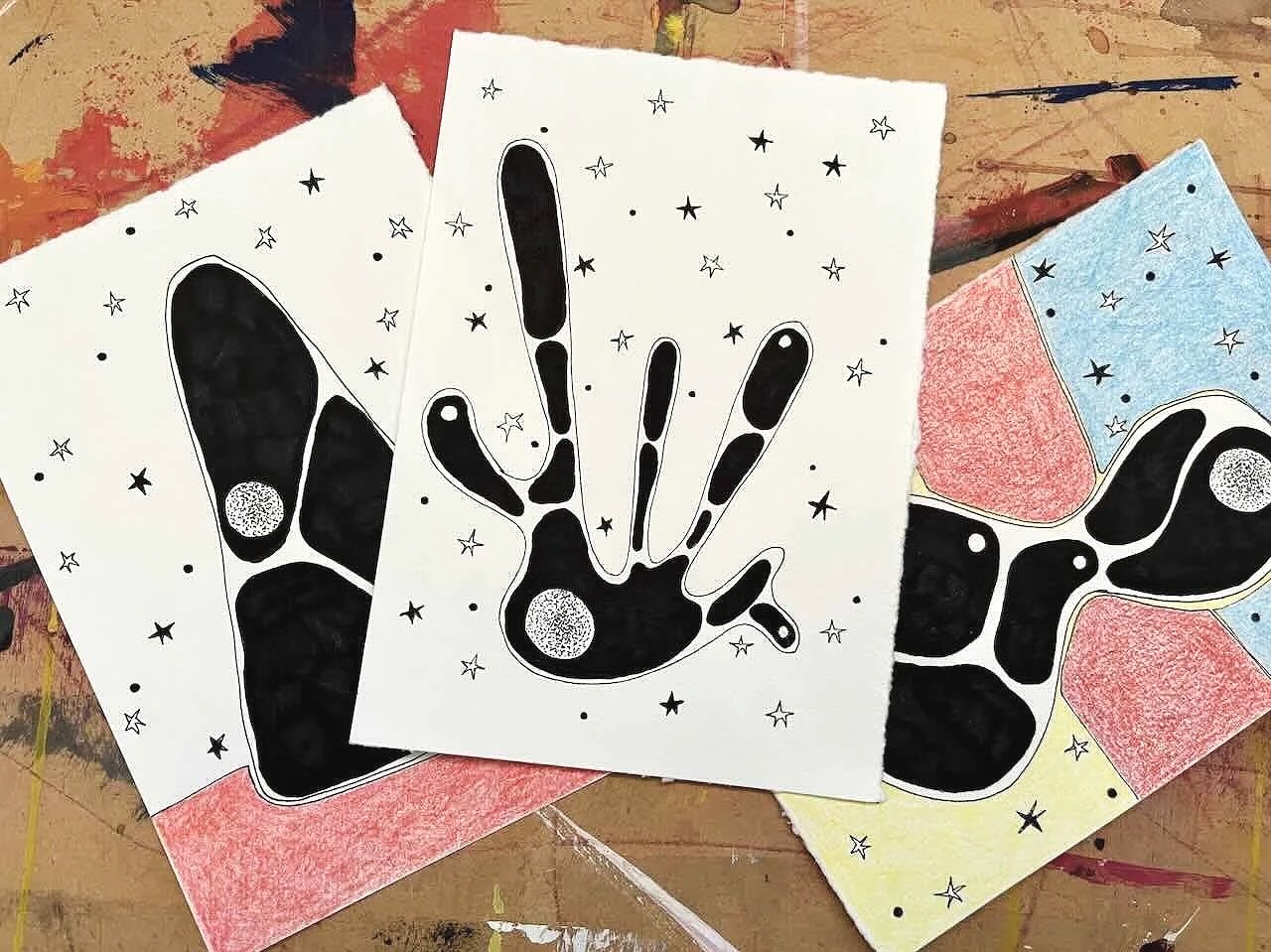
Moving the body with gentle attention keeps the mind moving too — so instead of circling around, our imaginations can journey.
We can also nudge our imaginations onward with simple prompts:
What colour/texture/sound/personality does this thought have? What if I gave it a hat?
Where could I take my imagination now? What comes next? What came before?
How could I explore a totally different perspective on this?
What does my curiosity wonder about here?
Feed our imagination good food
Finally, we can also focus on feeding our imagination good food. Our imaginations are drawing from the pool of our experience — and if we can stock the pool with curious, varied, strange, exciting, deep, engaging fish, then our imaginations will be more delicious.
This is a hard one, but I know from repeated experience that there are only so many episodes of your favourite cosy procedural crime drama you can watch before they start to colonise your imagination. Instead, we need a balanced diet of stories, ideas, conflicts, art, music, science, nature — whatever combination of curiosities feel tasty to your brain.
So there you have it — three ideas for looking after your imagination.
And the more we practise, the better we get. We start to develop a sense of safety around our imagination — and a sense of expansiveness — which is a huge gift to our creativity.
Let me know how you’re looking after your imagination this week, I’d love to hear from you: hello@kateyesberg.com.